Applications of Custom DNA-Shaped LED Displays
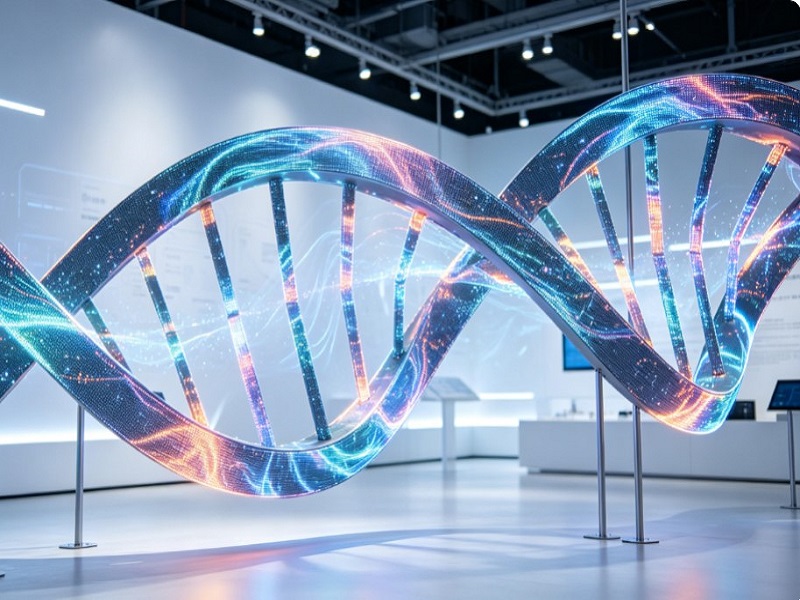
A DNA-shaped LED display does much more than showcase digital content. It creates an immersive visual landmark that instantly attracts attention and communicates themes of innovation, science, and technology. As a result, organizations across multiple industries increasingly use DNA LED screens to enhance visitor engagement and strengthen brand identity.
Science Museums and Technology Centers
Science museums and educational institutions often place DNA-shaped LED displays at the center of life science exhibitions.
The unique double-helix structure allows visitors to visualize complex biological concepts in a more intuitive way. At the same time, dynamic animations can demonstrate genetic sequencing, cell division, evolution, and other scientific processes.
Key Value:
- Makes scientific concepts easier to understand
- Combines education with interactive visual experiences
- Creates a memorable exhibition centerpiece
Biotechnology and Pharmaceutical Companies
Biotech companies, pharmaceutical manufacturers, and genetic testing firms frequently install DNA LED displays in showrooms, reception areas, and conference centers.
Because DNA represents the foundation of biological research, the display naturally reinforces the company's expertise and technological capabilities.
Key Value:
- Strengthens corporate branding
- Highlights innovation and scientific leadership
- Creates a premium visitor experience
Medical and Healthcare Facilities
High-end medical institutions increasingly incorporate creative LED displays into their interior design.
Facilities such as fertility clinics, genetic counseling centers, precision medicine institutes, and health screening centers use DNA-shaped LED screens to communicate professionalism and trust.
Furthermore, customized content can educate patients while enhancing the overall atmosphere.
Key Value:
- Reinforces a high-tech healthcare image
- Improves patient engagement
- Enhances interior aesthetics
Commercial Spaces and Entertainment Venues
Shopping malls, themed restaurants, bars, and entertainment venues constantly seek unique attractions that encourage social sharing.
A large DNA-shaped LED installation immediately becomes a focal point within the space. Visitors often stop to photograph or record the display, generating additional online exposure through social media.
Key Value:
- Creates strong visual impact
- Increases visitor dwell time
- Generates organic social media promotion
Trade Shows and Industry Events
Exhibitions and conferences are highly competitive environments where every exhibitor competes for attention.
A custom DNA LED display can help a booth stand out from hundreds of competitors. This is especially valuable at biotechnology expos, medical conferences, innovation summits, and scientific exhibitions.
The structure itself acts as a powerful marketing tool while supporting dynamic presentations and branded content.
Key Value:
- Attracts visitors from a distance
- Increases booth traffic
- Enhances brand recall
Public Art and Urban Installations
Cities and cultural organizations increasingly combine technology with public art.
DNA-shaped LED displays can function as illuminated sculptures for urban plazas, science parks, technology districts, and light festivals. By integrating motion graphics, interactive content, and artistic visual effects, these installations transform public spaces into engaging digital landmarks.
Key Value:
- Combines art and technology
- Creates iconic urban attractions
- Enhances public engagement
Important Challenges and Risk Factors
Although DNA-shaped LED displays deliver extraordinary visual impact, project planners should carefully evaluate several technical challenges before moving forward.
1. Structural Safety and Engineering Requirements
The double-helix structure introduces complex load distribution and shifting centers of gravity.
As the display size increases, structural engineers must perform detailed calculations for:
- Load-bearing capacity
- Wind resistance
- Seismic protection
- Torsional stress
- Installation stability
Without proper engineering, the long-term safety and reliability of the installation may be compromised.
2. Maintenance Complexity
Maintenance presents another significant challenge.
Unlike traditional flat LED walls, technicians cannot easily access every module inside a spiral structure. If an internal module fails, repairs may require partial disassembly of the display.
To minimize future maintenance costs, manufacturers should incorporate:
- Modular construction
- Quick-release mechanisms
- Accessible maintenance channels
- Front-service or hybrid-service designs
Proper maintenance planning during the design phase can significantly reduce downtime later.
3. High Content Production Requirements
Even the most advanced DNA-shaped LED display will struggle to achieve its full potential without specialized content.
Since the display surface follows a three-dimensional spiral path, conventional 16:9 videos often appear distorted or disconnected.
Organizations should plan for ongoing investment in:
- Custom 3D animations
- Scientific visualizations
- Interactive experiences
- Brand storytelling content
High-quality content ultimately determines whether the installation becomes a true attraction or simply an expensive structure.
4. Budget and Cost Efficiency
DNA-shaped LED displays require extensive customization, making them one of the most complex creative LED solutions available.
For organizations with limited budgets, a practical alternative may be a "pseudo-DNA" design.
This approach uses flat LED panels arranged to mimic the visual outline of a DNA helix rather than constructing a fully curved three-dimensional display.
Compared with a true DNA-shaped LED screen, this solution offers:
- Lower manufacturing costs
- Faster installation
- Simpler maintenance
- Reduced content mapping requirements
While it cannot fully replicate the immersive effect of a genuine double-helix display, it often delivers an attractive balance between visual impact and project budget.
Final Thoughts
A custom DNA-shaped LED display represents the perfect fusion of science, technology, architecture, and digital art. Whether installed in a biotechnology headquarters, science museum, medical facility, trade show, or public space, it immediately captures attention and communicates innovation.
However, successful implementation requires more than creative design alone. Careful planning, structural engineering, maintenance accessibility, and professional content creation all play critical roles in achieving long-term success. By addressing these factors early in the project, organizations can create a stunning visual landmark that delivers both educational value and lasting brand impact.


