Can-Shaped LED Display Cabinet Flatness Tolerance: How to Check Before Assembly
1. Why Does Cabinet Flatness Matter Before Module Assembly?
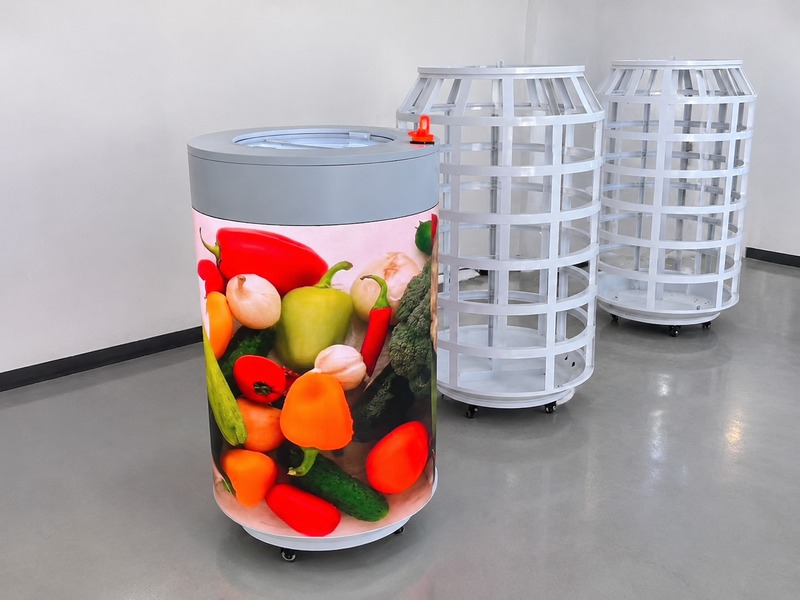
A can-shaped LED display has a curved cylindrical surface, a customized support frame, and multiple LED modules. Before installing the modules, manufacturers must check whether the cabinet structure matches the approved design.
One common problem is surface deviation. Some areas may be slightly higher or lower than others, while mounting points may not follow the same reference position.
Unlike a standard flat LED cabinet, a can-shaped structure cannot be checked by placing a straightedge across its entire curved surface. Engineers need to evaluate each section against its designed curvature and reference points.
If these deviations are not identified early, they may affect module positioning, connection gaps, and the final appearance of the screen.
2. What Problems Can Surface Deviation Cause?
Even small structural differences can create problems during module assembly.
Common issues include:
- Uneven module gaps: Neighboring modules may not connect smoothly.
- Surface steps: Some modules may sit higher or lower than adjacent sections.
- Uneven curvature: The cylindrical surface may look distorted from certain viewing angles.
- Installation pressure: Workers may need to force modules into position.
- Additional maintenance: Incorrect mounting positions can make future module replacement more difficult.
For a commercial can-shaped LED display, these problems can affect the overall visual quality. They may also increase production time if adjustments are required after assembly.
3. What Causes Cabinet Surface Deviation?
Several manufacturing and handling factors can change the cabinet's original geometry.
Material processing errors
Cutting, drilling, and bending operations may create dimensional differences. If the reference points are not controlled properly, mounting positions may become inconsistent.
Welding deformation
Heat generated during welding can cause local deformation. This is particularly important for customized metal frames with multiple connection points.
Uneven structural support
If the cabinet is not supported correctly during manufacturing or inspection, its weight may cause temporary or permanent deformation.
Transportation damage
Pressure, vibration, or accidental impact during transportation may change the position of brackets or cabinet sections.
Identifying these causes helps manufacturers determine whether the problem comes from material processing, structural assembly, or handling.
4. How to Identify Flatness Deviation Before Module Assembly
A practical inspection should combine dimensional measurement and surface profile checking.
Step 1: Confirm the reference drawing
Check the approved CAD drawing or 3D model before inspection. Confirm the cabinet dimensions, curvature, mounting positions, and structural reference points.
Do not use a standard flatness requirement for every section of a cylindrical cabinet.
Step 2: Establish reference points
Select several fixed points along the cabinet surface, including the top, bottom, middle, and module connection areas.
These points provide a consistent basis for comparing actual measurements with the design.
Step 3: Use suitable measuring tools
Different tools can help identify different types of deviation:
- Straightedge: Checks local surface irregularities on suitable reference sections.
- Feeler gauge: Measures small gaps between a reference tool and the inspected surface.
- Digital caliper: Checks dimensions and distances between mounting points.
- Dial indicator: Measures changes in surface position relative to a fixed reference.
- Laser measuring equipment: Helps compare multiple positions and overall geometry.
For curved sections, engineers should use a suitable profile template or coordinate measurement method rather than treating the entire surface as flat.
Step 4: Record the measurement results
Compare actual measurements with the approved engineering drawings. Mark areas that exceed the specified tolerance.
A measurement record makes it easier to identify repeated deviations and decide whether adjustments are necessary.
5. How to Verify Cabinet Accuracy Before Assembly
After the initial inspection, manufacturers should perform additional checks.
First, measure the distance between important mounting holes and fixing brackets. These positions must match the module installation design.
Second, inspect the transition between neighboring cabinet sections. Their connection surfaces should follow the intended cylindrical geometry.
Third, perform a trial installation using several representative LED modules.
During this process, check:
- Module alignment.
- Connection gap consistency.
- Surface height differences.
- Mounting point accuracy.
- Overall cylindrical shape.
If one module requires excessive pressure to fit, stop and inspect the mounting position. Forcing the module into place may hide the original structural problem.
There is no universal flatness tolerance for all can-shaped LED cabinets. The acceptable deviation should be specified in the project drawings according to cabinet dimensions, module design, and installation requirements.
6. Which Structures and Components Affect Flatness?
The final display surface depends on several connected components.
Customized cabinet frame: Provides the main structural support and determines the overall shape.
Curved LED modules: Must match the designed surface curvature and mounting arrangement.
Mounting brackets: Control the position and height of each module.
Connection components: Keep neighboring cabinet sections aligned during assembly.
Support frame: Maintains the overall cylindrical structure and distributes the display's weight.
These components should be designed and inspected as one system. Correct module dimensions alone cannot compensate for an inaccurate supporting structure.
7. Application Example: Can-Shaped LED Displays for Commercial Spaces
Imagine a beverage brand preparing a customized can-shaped LED display for a shopping mall or product exhibition.
The screen consists of multiple curved sections arranged around a cylindrical support frame.
Before module assembly, the production team checks the frame dimensions, mounting positions, and surface profile. Each section is compared with the approved 3D design.
During trial assembly, several modules are installed to check whether their edges follow the intended curve.
If a local surface deviation is found, technicians inspect the bracket position and supporting structure before continuing.
This approach helps prevent visible steps and uneven gaps after the complete display is assembled.
8. Frequently Asked Questions
Q1: What is cabinet flatness tolerance?
It refers to the permitted deviation of a surface from its specified reference plane or profile. For curved cabinets, the designed curvature must also be considered.
Q2: Can a straightedge be used to inspect a can-shaped LED cabinet?
Yes, for suitable local reference sections. However, it should not be used to judge the entire cylindrical surface as if it were flat.
Q3: What happens if surface deviation is found before assembly?
Technicians should identify the source, check the mounting brackets and frame, and correct the structural problem before installing the modules.
Q4: Should flatness be checked before or after module installation?
The supporting structure should be inspected before module installation. Additional surface and alignment checks should also be performed during trial assembly.
Q5: Can TOOSLED manufacture customized can-shaped LED displays?
Yes. TOOSLED provides customized LED display solutions in different shapes, dimensions, and pixel pitches according to project requirements.
9. Customized LED Display Manufacturing from TOOSLED
For a custom-shaped LED display, accurate manufacturing starts with structural design and continues through processing, assembly, and final inspection.
TOOSLED focuses on customized LED display manufacturing, including cylindrical, spherical, curved, and other irregular screen structures.
Our production process considers cabinet dimensions, module compatibility, mounting positions, and structural accuracy. Before delivery, products undergo inspection and testing to help identify potential manufacturing problems.
Whether you are planning a can-shaped LED screen for a shopping mall, exhibition, retail store, or brand showroom, proper structural inspection is an important part of achieving a reliable result.
Visit TOOSLED to explore our custom-shaped LED display solutions or contact our team to discuss your project drawings and manufacturing requirements.


