Escalator & Corridor Strip LED Display Solution
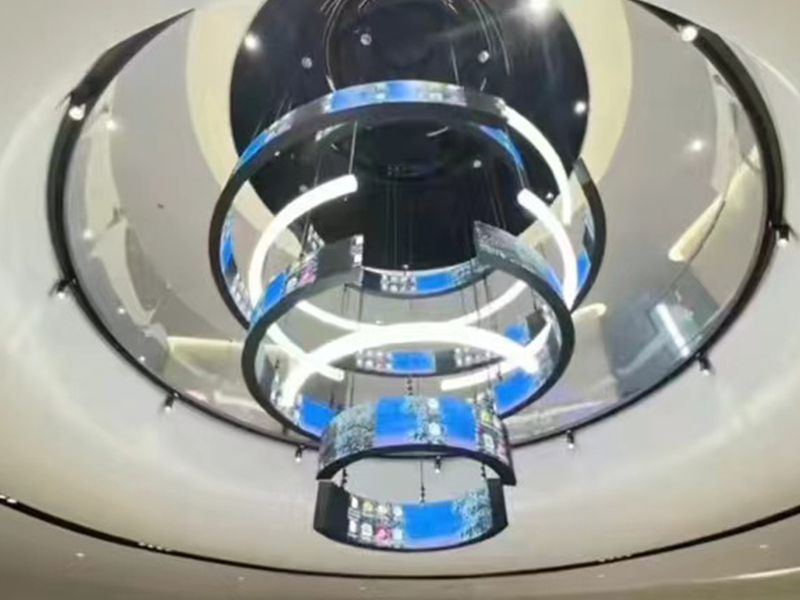
The strip LED display is engineered to follow architectural curves, edges, and linear pathways, such as escalators, corridors, ceilings, and handrails. Unlike conventional rectangular screens, this solution emphasizes continuity, immersion, and spatial storytelling.
By leveraging flexible module design and segmented cabinet structures, the display conforms to curved, inclined, or irregular surfaces, enabling a “flowing visual ribbon” effect that guides audience movement while maximizing advertising exposure.
2. Core Design Objectives
2.1 Spatial Integration
- Align the screen with escalator slopes or corridor curvature
- Eliminate visual interruption using custom-length cabinets
- Support concave/convex bending for architectural consistency
2.2 Continuous Content Flow
- Use ultra-wide aspect ratio content (e.g., 1:5, 1:10, or longer)
- Enable motion-guided visuals (e.g., flowing light, directional animation)
- Avoid traditional “cut-frame” content; prioritize panoramic storytelling
2.3 High Visibility in Dynamic Environments
- Escalators and corridors involve constant human movement
- Requires:
- High refresh rate (≥3840Hz) → eliminates flicker during motion
- Adjustable brightness (800–6000 cd/㎡) → adapts to indoor/outdoor lighting
3. Technical Configuration
3.1 Pixel Pitch Selection Strategy
| Scenario | Recommended Pitch | Rationale |
|---|---|---|
| High-end retail / museum | P1.2 / P1.5 / P1.8 | Close viewing distance, high detail |
| Shopping mall escalators | P1.9 / P2 / P2.5 | Balance between cost and clarity |
| Large corridors / exhibition halls | P3 / P4 | Mid-range viewing distance |
| Outdoor walkways / transport hubs | P5 / P6 / P8 / P10 | Long viewing distance, cost-efficient |
3.2 Environmental Adaptation
| Parameter | Indoor | Outdoor |
|---|---|---|
| Waterproof Rating | IP45 | IP65 |
| Brightness | 800–1500 cd/㎡ | 3000–6000 cd/㎡ |
| Protection | Dust + light moisture | Full weather resistance |
3.3 Performance Specifications
- Refresh Rate: 3840Hz–7680Hz
→ Ensures smooth visuals for moving audiences and camera shooting - Control System:
- Synchronous → Real-time content (concerts, live events)
- Asynchronous → Scheduled playback (advertising, retail)
4. Structural & Installation Design
4.1 Mounting Methods
A. Escalator Side Installation
- Mounted along handrail or side panels
- Requires anti-vibration reinforcement
- Use lightweight aluminum cabinets
B. Ceiling Suspended Strip
- Installed along corridor ceilings
- Creates “sky ribbon” visual effect
C. Wall-Embedded Linear Display
- Flush with architectural surfaces
- Achieves minimalist, seamless aesthetics
4.2 Modular Engineering
- Custom-length modules to avoid excessive seams
- Flexible PCB or segmented rigid modules for curvature
- Front maintenance design (magnetic or clip-lock system)
5. Content Strategy
5.1 Motion-Oriented Design
- Content should follow walking direction
- Use:
- Flowing gradients
- Directional arrows
- Animated light trails
5.2 Scene-Based Content Examples
| Scenario | Content Strategy |
|---|---|
| Shopping malls | Brand storytelling, promotions, seasonal campaigns |
| Concerts | Dynamic lighting sync, rhythm-based visuals |
| Exhibition halls | Narrative timelines, guided information flow |
| Museums | Immersive storytelling, historical sequences |
| Retail stores | Product highlights, limited-time offers |
| Hotels | Ambient visuals, branding, wayfinding |
| Science & tech museums | Data visualization, futuristic animations |
| Government (e.g., earthquake bureau) | Educational content, alerts, simulations |
6. Typical Application Scenarios
6.1 Commercial Advertising (High ROI)
- Escalator side screens in malls
- Continuous exposure during 30–60 seconds ride time
6.2 Immersive Exhibition Spaces
- Corridor “story tunnels”
- Enhances visitor engagement through sequential visual narratives
6.3 Entertainment Venues
- Concerts and live events
- Works as dynamic stage extension
6.4 Public & Institutional Spaces
- Museums, science centers, government halls
- Combines information + visual impact
7. Key Advantages of the Solution
- Architectural Integration → Screen becomes part of the building
- High Exposure Time → Captive audience on escalators
- Flexible Design → Supports curves, slopes, and custom layouts
- Wide Pixel Pitch Range → Adaptable to budget and distance
- High Visual Performance → Flicker-free, high brightness
8. Implementation Workflow
- Site Survey
- Measure curvature, length, viewing distance
- Custom Design
- Cabinet segmentation + structural drawings
- Simulation Rendering
- Visualize content flow before production
- Manufacturing
- Custom modules and cabinets
- Installation & Calibration
- Brightness, color uniformity, alignment
- Content Deployment
- Optimize for strip format
9. Conclusion
The escalator and corridor strip LED display solution transforms transitional spaces into high-impact visual channels. By combining flexible hardware design, high refresh performance, and motion-driven content, it delivers both commercial value and immersive spatial experience.


