Key Installation and Maintenance Challenges of Polyhedral LED Displays
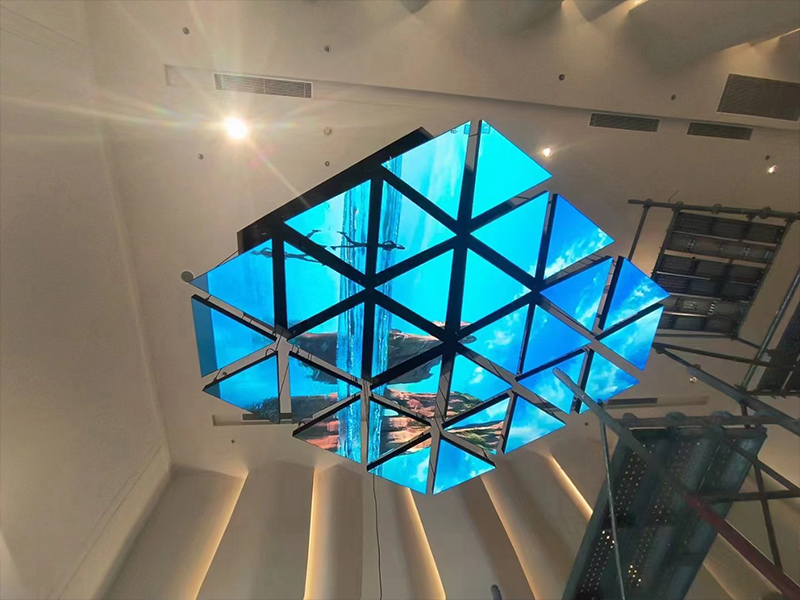
Polyhedral LED displays deliver strong visual impact and multi-angle visibility. However, compared to traditional flat screens, they introduce significantly higher technical complexity. If you plan to deploy one in a service hall or commercial space, you need to fully understand the installation and long-term maintenance challenges.
I. Installation Challenges
1. Extremely High Structural Precision Requirements
Unlike flat LED screens, polyhedral displays consist of multiple angled surfaces. Each face must align perfectly in terms of:
- Angle consistency
- Surface flatness
- Seam alignment
Even minor deviations can cause:
- Visible gaps
- Image misalignment
- Light discontinuity
As a result, installers must use custom steel structures and precise positioning systems. This increases both installation time and technical difficulty, while leaving very little room for error.
2. High Load-Bearing and Space Requirements
Polyhedral displays are typically installed as:
- Column-mounted structures
- Suspended (ceiling-hung) systems
- Column-wrapped designs
These configurations concentrate weight and shift the center of gravity, which introduces structural risks.
Therefore:
- Floors and ceilings must meet strict load-bearing standards
- Additional reinforcement may be required
- Civil engineering modifications are often necessary
3. Complex Cable Management and Concealment
Each face of the display requires:
- Power supply lines
- Signal transmission cables
When combined, these create a dense and complex wiring network.
However, service halls demand clean, modern aesthetics. This means:
- All cables must be fully hidden
- Routing must be carefully planned in advance
Compared to flat screens, cable management becomes significantly more difficult and time-consuming.
4. Difficult Calibration and Image Consistency
To achieve a seamless visual experience, technicians must calibrate:
- Brightness across all faces
- Color uniformity pixel by pixel
- Signal synchronization between surfaces
Because each face sits at a different angle, light reflection varies, which often leads to:
- One side appearing brighter
- Another appearing darker
As a result, calibration requires extensive time and expertise to ensure visual consistency.
II. Operation and Maintenance Challenges
1. Limited Maintenance Access
Most polyhedral displays feature enclosed or semi-enclosed structures. This creates:
- Narrow internal spaces
- Limited access to rear components
When failures occur (e.g., dead LEDs or faulty modules):
- Disassembly becomes complicated
- Maintenance takes longer than with flat screens
2. Heat Dissipation Issues
Polyhedral designs often form semi-enclosed volumes, which restrict airflow.
Consequently:
- Heat accumulates internally
- LED lifespan may decrease
- Risks of black screens or display artifacts increase
To mitigate this, you must implement:
- Active cooling systems (fans, ventilation)
- Thermal design optimization
3. Higher Failure Probability
Compared to flat displays, polyhedral screens involve:
- More modules
- More corner connections
- More signal and power interfaces
Each additional connection point introduces potential failure risk. Even a minor contact issue can affect the overall display performance.
In high-traffic environments like service halls, any visible malfunction directly impacts brand or institutional image.
4. High Post-Calibration Costs
Over time, LED modules experience:
- Brightness decay
- Color shift
For polyhedral displays, recalibration must be performed across all faces simultaneously.
You cannot simply replace a single module because:
- New modules will differ in brightness and color
- This creates obvious visual inconsistencies
Therefore, maintenance often involves full-system recalibration, which increases cost and complexity.
5. Cleaning Complexity
Polyhedral structures include:
- Multiple edges
- Corners
- Narrow gaps
Dust and fingerprints tend to accumulate in these hard-to-reach areas.
Unlike flat glass surfaces:
- Cleaning requires careful handling
- Improper methods may scratch or damage the display
As a result, routine cleaning becomes slower and more labor-intensive.
6. Higher Technical Requirements for Maintenance Teams
Polyhedral LED systems demand more than basic electrical skills.
Maintenance personnel must understand:
- Multi-surface image mapping
- Signal synchronization
- Advanced calibration techniques
When issues arise:
- Fault detection is more complex
- Identifying the exact problem area takes longer
This means organizations must rely on skilled LED technicians, not general electricians.
Conclusion
Polyhedral LED displays offer clear advantages in visibility and design impact, but they come with substantial technical challenges. From precision installation and structural engineering to ongoing maintenance and calibration, every stage requires specialized expertise.
If you address these challenges properly—through careful planning, professional installation, and skilled maintenance—you can fully unlock the value of polyhedral LED technology while avoiding costly operational issues.


