Outdoor Curved LED Screens: Rigid Modules and Structural Design
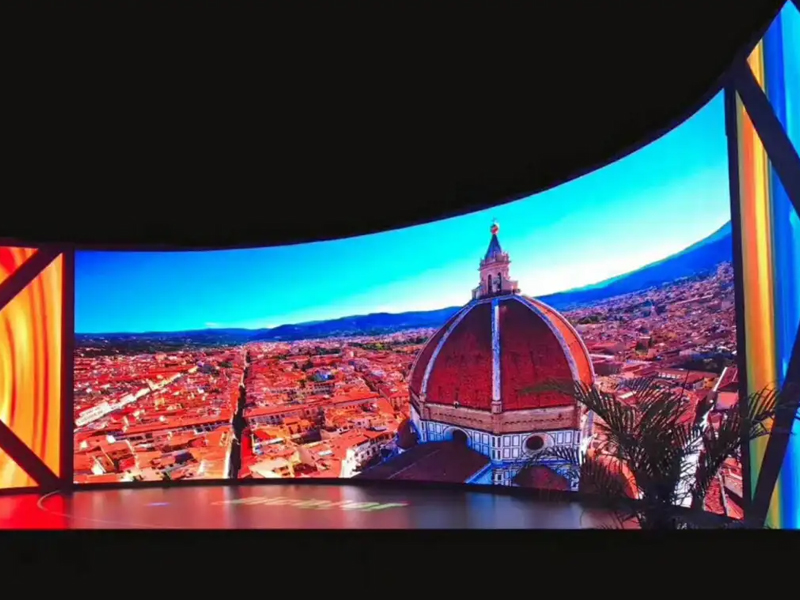
Outdoor conditions introduce significant challenges, including rain, UV exposure, wind, and temperature fluctuations. Because of this, flexible “soft” modules are not suitable for most outdoor projects—especially when you need high brightness and full-color performance.
Instead, outdoor curved LED displays rely on two mainstream approaches:
Solution A: Rigid Modules with Built-in Angles (Mainstream Choice)
This is the most widely used method for outdoor curved LED screens.
How It Works
Manufacturers design the module housing with a predefined angle—for example, 1.5° or 2.5° on each side. When you assemble multiple modules, these small angles combine to form a smooth overall curve.
Advantages of Toosen's Outdoor Curved LED Display
- High durability with reinforced materials
- Excellent waterproofing (IP65 or higher)
- Efficient heat dissipation
- Stable performance in harsh environments
Because of these benefits, this solution dominates outdoor applications that require reliability and visual consistency.
Solution B: Curved Cabinets with Flat Modules
When the curvature radius is large—such as on building facades or architectural corners—you can achieve the curve through adjustable cabinets instead of angled modules.
How It Works
The LED modules remain flat, but the cabinet structure includes adjustable locking mechanisms that allow installers to set specific angles between panels.
Visual Effect
This method essentially uses straight panels to approximate a curve. However, when the radius is large enough, the human eye perceives the surface as smooth and continuous.
Key Differences at a Glance
| Feature | Indoor Curved Screens | Outdoor Curved Screens |
|---|---|---|
| Core Technology | Flexible PCB (soft modules) | Rigid modules / angled cabinets |
| Protection Level | Low (≈ IP30) | High (≥ IP65, sealed) |
| Surface Smoothness | Excellent, seamless curves | Very good (best with large radius) |
| Installation | Magnetic mounting / light frames | Cabinets + steel structure |
| Durability | Limited | High, weather-resistant |
Special Case: Outdoor Flexible Displays
You may encounter outdoor flexible solutions such as mesh screens or LED strip displays. These products can bend and are often used for media facades or landmark lighting.
However, if your project requires high resolution, high brightness, and full-color visuals, the industry standard still favors rigid modules with built-in angles. They deliver better image quality, durability, and long-term stability.
Conclusion
In LED display design, the environment dictates the technology. Indoor curved LED displays benefit from flexible modules that prioritize aesthetics and precision. Meanwhile, outdoor applications demand robust, weatherproof solutions built around rigid modules and structural engineering.
By choosing the right approach from the start, you not only achieve the desired visual effect but also ensure safety, durability, and cost efficiency over the lifecycle of the project.


