What Is a “Time Tunnel” LED Video Wall?
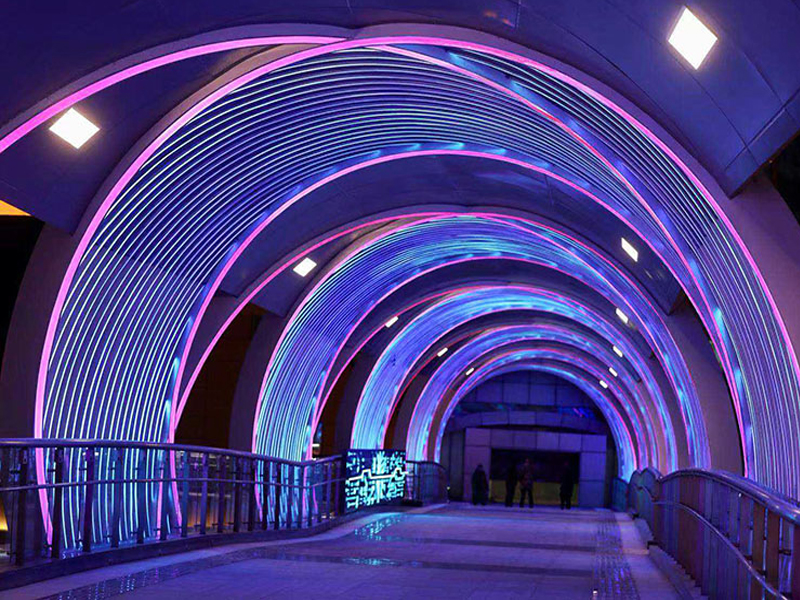
A time tunnel LED display is an immersive visual installation built inside a corridor or tunnel-like space. It uses LED screens on three or four sides to fully surround the viewer. By combining synchronized visuals with perspective-driven content, the system creates the illusion of traveling through space and time.
You’ll commonly see these installations in science museums, exhibition halls, shopping malls, and cultural tourism attractions because they attract attention and keep visitors engaged.
Structural Configurations
Different layouts serve different use cases. Here are the most common configurations:
| Type | Description | Typical Applications |
|---|---|---|
| Three-sided tunnel | LED screens on the floor and both side walls; ceiling may be open or covered | Mall corridors, exhibition walkways |
| Four-sided tunnel | Full enclosure with LED on the floor, ceiling, and both walls | Immersive experience centers, theme parks |
| Curved / circular tunnel | 360° curved or ring-shaped LED structure | Flying theaters, simulation environments |
| Custom-shaped tunnel | Irregular structures combined with mechanical movement | Interactive art installations |
Key Technical Specifications
To achieve a smooth and immersive experience, you need to get the technical details right:
- Pixel pitch: Typically P1.5–P3 for high resolution. Flexible LED modules are often used for curved surfaces.
- Refresh rate: ≥ 3840 Hz to eliminate flicker during filming and photography.
- Brightness: 800–1500 cd/m² for indoor use, with adaptive brightness for changing ambient light.
- Synchronization: Multi-channel frame sync under 1 ms to ensure seamless visuals across all surfaces.
- Floor load capacity: Dynamic load ≥ 500 kg/m², with anti-slip and wear-resistant treatment.
Content Design and Immersive Experience
Strong content is what makes the tunnel truly memorable. Designers usually focus on highly dynamic, perspective-driven visuals.
Popular Visual Themes
- Space travel: Nebulas, wormholes, interstellar journeys
- Natural wonders: Deep ocean scenes, underground exploration, seasonal transitions
- Urban timelines: Historical reconstructions and futuristic cityscapes
- Abstract art: Particle systems, data visualization, geometric light effects
These themes work well because they enhance depth perception and motion, which are critical for immersion.
Typical Project Examples
- Guangzhou Grandview Polar Ocean World: Uses an LED ceiling tunnel to simulate deep-sea lighting effects
- Hongyadong Time Tunnel in Chongqing: Combines tourism and retail to create a viral photo spot
- Science museums: For example, immersive corridors in future-tech themed exhibition halls
- Theme parks: Widely used in pre-show or queue areas in parks like Disney and Universal
Design and Installation Considerations
To ensure long-term performance and safety, you should address these key factors early in the project:
- Thermal management and maintenance
Enclosed tunnels trap heat easily, so you must design proper ventilation or air conditioning. At the same time, reserve front-access maintenance space. - Safety protection
Use anti-slip flooring (≥ R10 rating) and integrate clear emergency exit signage. - Structural load
The steel structure must handle dynamic loads and meet seismic design requirements. - Content management
Plan ahead for a control system that supports remote updates. This allows you to refresh content without interrupting operations.
In short, a time tunnel LED display is not just a screen system—it’s a fully integrated experience that combines hardware, structure, and content. When all three work together, the result feels immersive, intuitive, and visually unforgettable.


